Ditching the Car Note: How Real Americans Are Trading Monthly Payments for Bike-Share — and Keeping Thousands
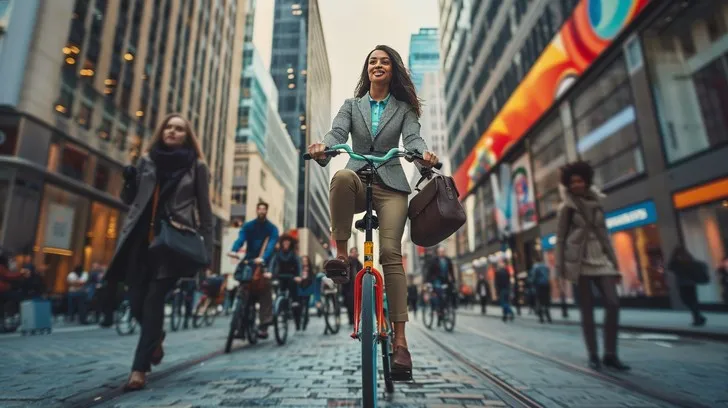
Photo: young professional riding bike share city street urban commute, via images.stockcake.com
Jamila moved to Denver three years ago with a car, a parking spot, and a monthly insurance bill that made her wince every time the autopay notification hit her phone. Last spring, she sold the car. She hasn't looked back.
"People thought I was having some kind of crisis," she laughs. "Like, who voluntarily gets rid of their car? But honestly? It's the best financial decision I've made since I started my 401(k)."
Jamila is not an outlier anymore. Across American metros — from the obvious ones like Portland and Seattle to more surprising markets like Columbus and Kansas City — a quiet but unmistakable shift is happening. Young professionals, families, retirees, and recent transplants are deliberately stepping off the car ownership treadmill and building their lives around bike-share, public transit, and a patchwork of on-demand mobility options. The savings are real. The lifestyle changes are real. And the ripple effects are bigger than most people expect.
Let's Talk About the Money First
Because it's genuinely wild when you lay it out.
The average American spends somewhere north of $12,000 a year on car ownership when you factor in the monthly payment, insurance, gas, parking, registration, and maintenance. In major cities, that number climbs higher — parking alone in cities like Boston or San Francisco can run $300 to $500 a month.
A bike-share membership, by comparison, typically runs between $100 and $200 a year for unlimited short rides. Add a transit pass — let's say $1,200 annually in a mid-size city — and maybe a occasional rideshare for trips that don't fit neatly into either option. You're still looking at total annual mobility costs well under $3,000 in most cases. Often much less.
That's a gap of $9,000 or more. Every year. For a lot of households, that's the difference between financial stress and financial breathing room.
Marcus, a 34-year-old teacher in Minneapolis, did the math in a spreadsheet after his car needed a $2,200 repair. "I sat down and actually calculated what I was spending, and I felt kind of sick," he says. "I was paying for a car I used maybe four times a week. The other three days I was taking the bus anyway."
He sold the car six months ago. He's been using Bike-share for his daily commute and estimates he's saved close to $800 a month. He used part of it to pay off a credit card. The rest, he says, "just feels like freedom."
It's Not Just About the Money
Here's the thing that surprises almost everyone who makes this switch: the financial savings end up being almost secondary to the other changes.
People talk about stress. Specifically, the absence of it. No hunting for parking. No sitting in traffic watching the minutes tick away. No anxiety about whether a weird noise under the hood is a $200 fix or a $2,000 one.
There's also the physical dimension. Riding a bike — even a shared one, even for a 12-minute commute — adds incidental movement to your day in a way that sitting in a car simply doesn't. People report sleeping better, feeling less mentally foggy, and arriving at work in a better mood. (We've written about the mental health angle before, and the research backs it up.)
And then there's the city itself. When you stop moving through it in a sealed metal box, you start actually experiencing it. You notice the coffee shop that opened on the corner. You recognize faces. You become, in a small but real way, part of the neighborhood instead of passing through it.
"I know my block now," says Priya, a 29-year-old marketing manager in Washington D.C. who gave up her car two years ago. "I know the guy who runs the hardware store. I know which streets have the best shade in July. I didn't know any of that when I was driving."
Which Cities Are Leading the Shift?
The data tells an interesting story. Cities with robust, well-integrated bike-share networks are seeing the fastest growth in car-free and car-lite households among young adults. That tracks.
New York has always had a large car-free population by necessity, but Citi Bike's expansion into outer boroughs has meaningfully extended that lifestyle to neighborhoods where it wasn't previously viable. Chicago's Divvy network has seen membership growth in neighborhoods on the South and West sides as the system expands its coverage. In smaller cities, the picture is more uneven — but places like Pittsburgh, Salt Lake City, and Tucson are showing real momentum.
What these cities have in common isn't just bike-share — it's integration. Bike-share works best when it connects to transit, when the street infrastructure is safe enough that people feel comfortable riding, and when the membership pricing is accessible enough that it's genuinely a financial win rather than a lifestyle luxury.
Cities that have invested in protected bike lanes alongside their bike-share programs are seeing the most significant mode shift. Turns out, people will ride bikes in large numbers when they don't feel like they're taking their lives in their hands.
The Stuff Nobody Warns You About
Let's be honest about the friction, because there is some.
Rainy days are real. So are grocery runs that require more bags than you can comfortably carry on a bike. So are the moments when you're running late and the nearest bike-share station is empty or the app is glitching.
Most people who've made the switch develop systems. They learn which errands can be batched for a rideshare day. They invest in a good rain jacket. They figure out which routes have reliable station availability. It takes a few weeks to find your rhythm, and there are definitely days when you miss just having a car sitting in the garage.
But the people we talked to — almost universally — say they wouldn't go back. The financial relief is too significant. The daily experience is too much better. And there's something that's hard to articulate but very real about the feeling of having opted out of a system that was quietly draining you.
The Bigger Picture
What's happening here isn't just a personal finance story. It's a cultural shift. The assumption that car ownership is a necessary marker of adulthood — that you're not really a functioning American without a vehicle in your name — is loosening its grip, at least in cities.
That has implications for urban planning, for housing density, for the tax revenues that flow from gas and parking. It has implications for how we build cities going forward and who gets to live where.
At Grid Bike Share, we're not here to tell you to sell your car. We're here to tell you the math is real, the lifestyle is possible, and more and more people are discovering that the grid — the network of bikes, buses, trains, and sidewalks that already exists in your city — might be more than enough to get you where you're going.
Sometimes the smartest ride is the one that costs you the least.