Unlocking the Bike You Keep Walking Past: The Psychology of the First Ride
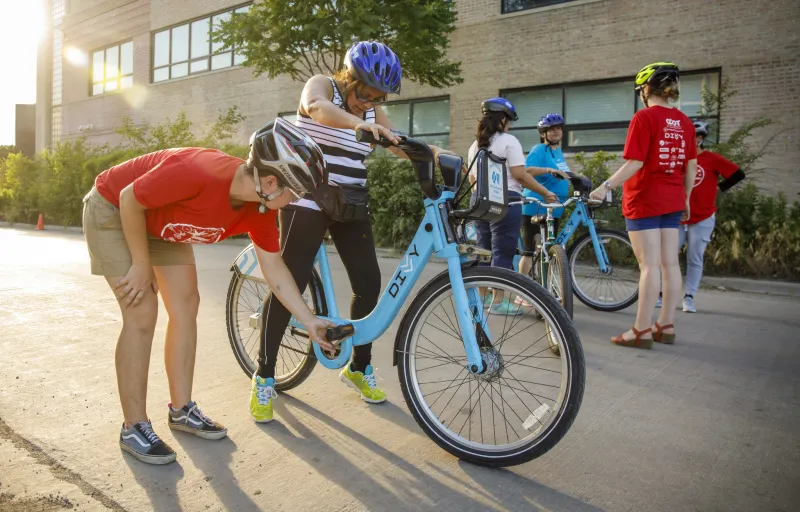
Photo: nervous adult learning to ride bike share city parking lot class, via adultlearnersweek.org
There's a station on the corner of Maria's block in Chicago. She walks past it twice a day, every day, on her way to the Logan Square Blue Line. She could tell you the app by its logo. She has never unlocked a single bike.
"It's not that I don't want to," she told us, laughing a little at herself. "I've just convinced myself I'd be terrible at it. Like everyone on a bike in this city got some memo I missed."
Maria isn't rare. She's the norm. Industry surveys consistently show that a huge share of Americans living within a few blocks of a bike-share station have never used it — and the barriers keeping them off the saddle have surprisingly little to do with price, weather, or even convenience. They're psychological. And the cities that have figured that out are quietly changing their ridership numbers one nervous first-timer at a time.
The Fear Mile
Ask people why they don't ride and the answers cluster around one theme: other cars. Traffic anxiety is the big one — the imagined moment of merging into a lane of impatient SUVs, the fear of doing something wrong in front of a line of honking drivers. For people who haven't been on a bike since childhood, the city reads as hostile territory, not a network of streets they have a legal right to use.
Then there's the equipment spiral. "Do I need a helmet? Where would I even put one? What if I sweat through my work shirt? What if I get to a dock and it's full?" Each question is small. Stacked together, they form a wall.
And underneath all of it sits something harder to name: belonging. Watch a dock at rush hour and you'll see who feels entitled to it — commuters in technical gear who move like they've done this a thousand times. For everyone else, that confidence can look like a membership requirement. Research on cycling adoption keeps finding the same thing: people don't avoid biking because they can't do it. They avoid it because they're not sure it's "for someone like me."
What Actually Works
Here's the good news: the fear mile is very crossable, and cities are learning exactly how to help people cross it.
The most effective programs aren't marketing campaigns. They're low-stakes, in-person, and honestly kind of delightful. Think learn-to-ride sessions in a closed parking lot on a Saturday morning, where adults in their 30s, 50s, and 70s wobble around cones while an instructor reminds them that braking with both hands is, in fact, allowed. Philadelphia, Portland, and Washington, DC have all run variations of these, often partnering with community groups to make sure the invite reaches people who've never seen themselves as "cyclists."
A few patterns show up in every program that works:
- Practice without traffic first. Confidence in a parking lot transfers to the street. Confidence from a YouTube video does not.
- Ride with a buddy. First rides taken alongside a guide — a program staffer, a neighbor, a volunteer — convert at dramatically higher rates than solo attempts.
- Start with the easy route. One quiet, protected path from home to a familiar destination. Not a commute. Just a trip to the farmers market.
- Normalize the helmet question. Programs that hand out helmets or simply talk through the risk honestly remove one more excuse before it hardens into a rule.
The results are blunt. Cities running these programs report that a large share of attendees go on to become regular riders within a season. The bike didn't change. The story people told themselves about the bike changed.
You're Allowed to Be Bad at It First
If you've been circling that station on your block for months, here's the permission slip: nobody is grading your first ride. The person who unlocked the bike next to you this morning was terrified once, too. The wobble is temporary. The route can be quiet. The helmet can come from a thrift store.
And honestly? The fear mile might be the shortest mile you ever ride. Maria, for what it's worth, finally did it — a Saturday, a lakefront path, eleven minutes of pure white-knuckle concentration followed by something she described as "embarrassingly fun." She's commuted by bike-share twice since.
The station was always there. Turns out it was waiting for her the whole time.