Hills, Who? The E-Bike Is Quietly Redrawing the Map of American Bike-Share
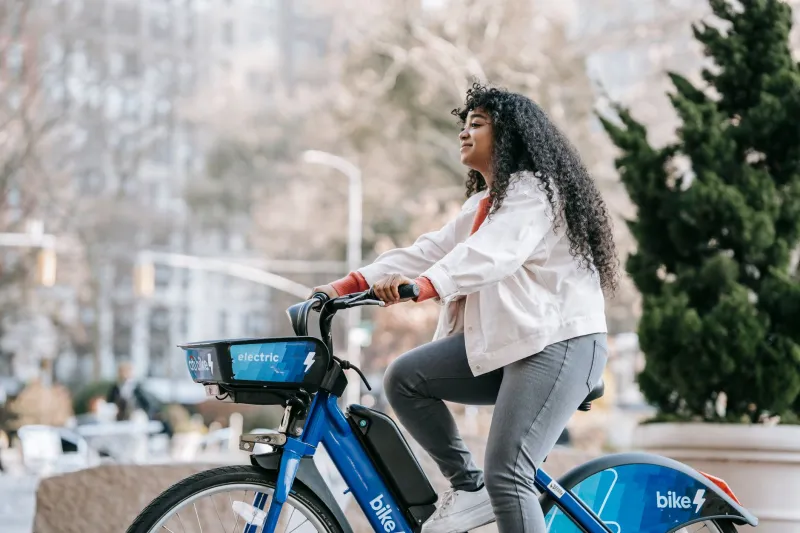
There's a moment every new e-bike rider knows well. You roll up to a hill that used to be a dealbreaker, give a little extra push on the pedals, and the motor hums to life beneath you. Halfway up, you realize you're smiling. The hill didn't go anywhere — your excuse for avoiding it did.
That moment, multiplied by millions of rides, is quietly reshaping bike-share across the United States.
The Numbers Don't Pedal Themselves
When systems like Citi Bike in New York and Capital Bikeshare in Washington, D.C. added electric pedal-assist fleets, the data told a striking story. E-bikes get ridden more often than their pedal-only siblings — in some cities, two to three times as frequently. Average trip distances stretch out, sometimes by a mile or more. And ridership holds up in weather that would normally empty the docks.
But the raw stats miss the bigger shift: who is riding.
Sweating the Small Stuff — Or Not
Ask people why they don't bike to work and the answer is rarely about bikes. It's about sweat. It's about arriving at a client meeting with a damp shirt and a story about a headwind. E-assist dissolves that objection almost entirely. A pedal-assist motor takes the edge off the effort, so a five-mile commute feels like a stroll — you still move, you still get light exercise, but you show up looking like you took the elevator, not the stairs.
That's a game-changer in hot, humid places. In Houston, Memphis, and Miami, summer commuting on a traditional bike has always been a hardcore pursuit. E-assist turns it into a reasonable Tuesday.
Flattening the Geography Problem
Some American cities were simply built too steep for casual cycling. Pittsburgh's hills are legendary. Seattle's topography reads like a seismograph. San Francisco basically invented the cable car to solve this exact problem.
E-bikes rewrite that map. A slope that once filtered out all but the fittest riders becomes a mild incline with a helpful tailwind. Bike-share operators in hilly cities report that e-bike trips routinely cover routes that pedal bikes almost never touched — meaning the network suddenly serves neighborhoods it had effectively locked out.
The Sun Belt Surprise
Here's the twist nobody predicted a decade ago: some of the strongest e-bike growth isn't in dense, bike-friendly coastal cities. It's in sprawl.
Phoenix. Las Vegas. Dallas. These are places engineered around the automobile, where a trip to the grocery store can be a fifteen-minute drive. Traditional bike-share struggled there because distances were long and comfort levels were low. E-assist changes the math on both counts — longer trips become feasible, and the effort required drops to something a lifelong driver can see themselves doing.
For commuters in these metros, an e-bike isn't a lifestyle statement. It's a second car replacement, or sometimes a first-car avoidance strategy. When you stack up a car payment, insurance, and parking against a bike-share membership, the spreadsheet starts making the argument on its own.
Older Riders, New Wheels
One of the most welcome trends: e-assist is bringing older Americans back into the saddle. Knees are honest negotiators, and a motor that softens hills and headwinds means a 68-year-old can ride with grandkids or commute to a part-time job without paying for it the next morning.
Bike-share systems that added e-fleets report a broader age spread among riders — not just the twenty-something urban core that powered early adoption. That matters for the future of the movement. A bike-share network that only serves one demographic is a niche product. One that serves a retired teacher in Tucson and a barista in Brooklyn is infrastructure.
The Catch: Keeping the Grid Charged
None of this is free. E-bikes cost more to buy and maintain, batteries need swapping and charging, and a dead dock in a busy corridor can frustrate riders fast. Operators are learning on the fly — solar-assisted charging stations, swappable battery packs, and rebalancing algorithms that account for charge levels alongside demand.
There's also an equity question worth watching. If e-bikes cost more per ride, cities need to make sure the benefit doesn't flow only to riders who can pay a premium. Discounted memberships and reduced-fare programs that cover e-assist, not just pedal bikes, are how systems keep this from becoming a two-tier network.
The Road Ahead
The pedal-assist boom isn't a gadget fad — it's the moment bike-share stopped asking people to meet the bike halfway. For decades, cycling advocates asked riders to get fitter, get braver, get sweatier. E-assist flips the deal: the machine meets you where you are.
Hills, heat, distance, age, sweat — the old objections are dropping one by one. What's left is the simple pleasure of moving through a city under your own power, with a quiet motor smoothing out the rough parts.
The map of American bike-share is being redrawn. And honestly? It's looking a lot bigger than it used to.