Your Neighborhood's Report Card: Measuring the 15-Minute Promise, One Dock at a Time
Somewhere in a conference room right now, a city planner is pointing at a map with concentric circles drawn around a neighborhood center. Fifteen minutes by foot or bike to everything you need: groceries, a pharmacy, a clinic, a job. It's the 15-minute city, and it's become the darling of urbanist think pieces from Portland to Philadelphia.
But here's the thing nobody puts in the keynote slides: for most Americans, the 15-minute city isn't a walking concept. It's a biking concept. And bike-share — not sidewalks, not fantasy light-rail lines — is quietly deciding which neighborhoods actually get to live the promise.
The Distance Problem Nobody Wants to Talk About
Let's do the math your city's planning department avoids. Fifteen minutes on foot gets you about three-quarters of a mile. Fifteen minutes on a bike — even a heavy, step-through share bike with a basket — gets you three miles, easy. That's not a marginal improvement. That's a twelvefold expansion of your world.
A grocery store that's an unreachable 40-minute walk becomes a breezy 10-minute ride. A community college across the river becomes a realistic commute. The urgent care clinic in the next neighborhood stops being an Uber ride and starts being something you can do on your lunch break.
In other words, bike-share isn't a nice-to-have amenity bolted onto the 15-minute city. In most American metro areas, it's the delivery mechanism. Which makes dock placement less of a logistics question and more of a civil rights question — but we'll get there.
Grading the Real-World Report Card
So which neighborhoods are actually passing? Look at the ones where planners treated bike-share as essential infrastructure rather than downtown decoration.
Minneapolis gets high marks. The Nice Ride network historically seeded docks near the Midtown Greenway and in South Minneapolis, connecting residents to the Midtown Global Market, clinics along Lake Street, and jobs downtown. When your bike network plugs into your trail network and your commercial corridors, the 15-minute math starts working for regular people, not just downtown office workers.
Washington, D.C. remains the American proof of concept. Capital Bikeshare's dense station grid means a huge share of residential neighborhoods — not just the monuments and the Mall — sit within a five-minute walk of a dock. The result: a pharmacist in Columbia Heights can reach groceries in Petworth, a job interview in NoMa, and a doctor's appointment in Shaw, all without owning a car.
Philadelphia's Indego has made deliberate equity pushes into Kensington and North Philly, neighborhoods where the distance between a bodega and a full supermarket can be measured in food-desert miles. Every dock added there isn't a transportation stat — it's a grocery access stat.
Now the failures. Plenty of cities launched bike-share with docks clustered in the tourist core and the wealthiest zip codes, then called it a day. The result is what advocates have started calling "15-minute cities for some": a downtown where every need is a pedal away, surrounded by neighborhoods where the nearest dock is a mile off and the nearest supermarket is two.
The Dock Placement Gap
Here's the uncomfortable pattern that shows up in city after city: the neighborhoods that most need bike-share — lower-income areas, places with low car ownership, communities far from full-service grocery stores — are chronically the last to get docks.
The excuses are familiar. Lower projected ridership. Higher vandalism rates on paper. Station siting fights with residents who don't want infrastructure in front of their homes. But each of these excuses compounds the original inequity. You can't cite low ridership in a neighborhood where you never built the infrastructure in the first place. That's not data — that's a self-fulfilling prophecy.
The cities doing it right have started flipping the model. Instead of asking "where will bike-share get the most use?" they're asking "where would a bike change the most lives?" That means prioritizing docks near affordable housing, community health centers, and transit deserts — even if the ridership numbers take a season or two to catch up.
What Planners Should Steal
If you're in a city hall reading this, here's the short version:
Map needs, not demand. Overlay your bike-share map with food access data, clinic locations, and job centers. The gaps in that overlay are your dock expansion plan.
Count the 15-minute radius, not the dock count. A neighborhood with two docks that don't reach the grocery store or the school has zero effective bike access, no matter what the press release says.
Pair docks with safe streets. A dock on a four-lane arterial with no bike lane is a taunt, not an amenity. The 15-minute promise only holds if the ride between destinations doesn't require courage.
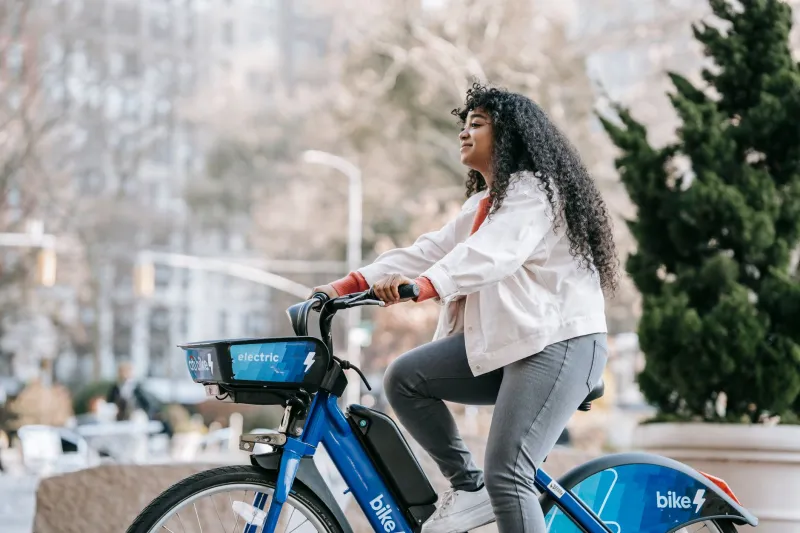
Treat e-bikes as equity tools. Electric assist flattens hills and stretches the 15-minute radius even further — which matters enormously in hilly cities like Pittsburgh, Cincinnati, and Seattle.
The Future Is a Short Ride Away
The 15-minute city was never really about walking. It was about proximity — about building (or retrofitting) neighborhoods where daily life doesn't require a two-ton vehicle and a parking space. Bike-share is the cheapest, fastest, most scalable tool American cities have for making that proximity real.
The question isn't whether bike-share can deliver the 15-minute city. D.C., Minneapolis, and Philadelphia have already shown it can. The question is whether the next wave of expansion will reach the neighborhoods that need it most — or whether we'll keep building 15-minute cities inside a few lucky downtowns and calling it progress.
Every dock is a decision. Place them like it matters.